Liquid rocket engine analysis and six-degree-of-freedom flight simulation, as a desktop application and a Python library.


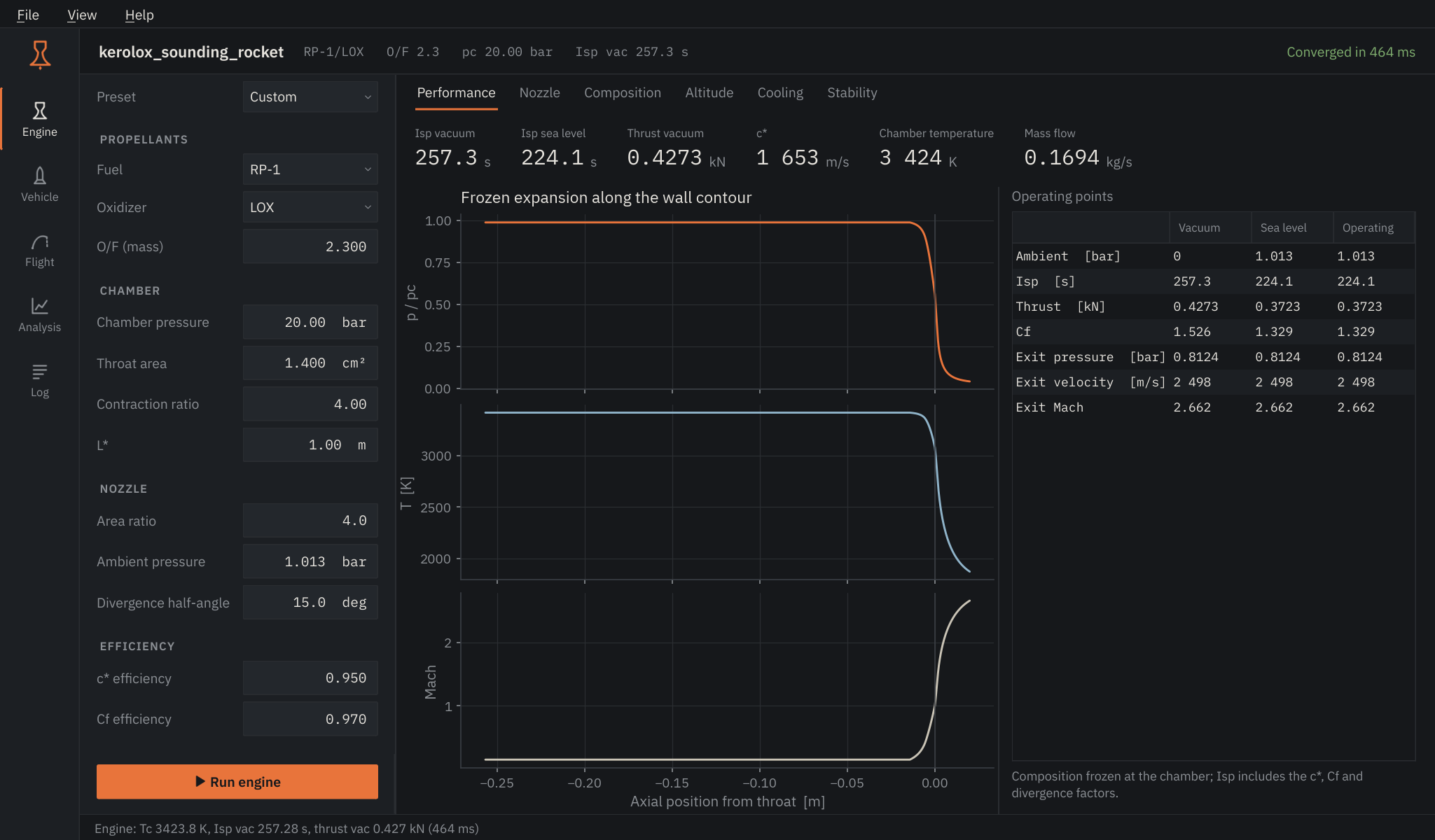
Pick two propellants, a mixture ratio and a chamber pressure. EnSim finds the chamber equilibrium, expands the gas through the nozzle and gives you Isp, thrust and the composition of the exhaust, matching NASA CEA to within 0.05 %. From there you can draw and cool the chamber, put the engine in a rocket, fly it from the rail to landing and scatter a few hundred flights to see where it comes down.
Documentation: https://spaceengineerss.github.io/EnSim/
The desktop application:
$ pip install "ensim[gui]"
$ ensim
or a self-contained download for Windows, macOS and Linux from the releases page.
The library and the command line only, without Qt:
$ pip install ensim
$ ensim engine --fuel LCH4 --of 3.4 --pc 100 --eps 35 --throat-area 200
Python 3.10 or newer.
from ensim.core.engine import EngineInputs, analyze_engine

engine = analyze_engine(EngineInputs(
    fuel="LCH4", oxidizer="LOX", of_ratio=3.4,
    chamber_pressure=100e5, expansion_ratio=35, throat_area=0.02,
))
engine.chamber_temperature                 # 3598.0 K
engine.vacuum.isp, engine.sea_level.isp    # 337.7 s, 272.2 s
engine.vacuum.thrust                       # 366.0 kN
Flights, dispersion studies, staging and the lower-level solvers are covered in the library guide.
| Chamber | Gibbs minimisation over the NASA Glenn species set, propellants in their storage state |
| Nozzle | Frozen isentrope with temperature-dependent heat capacity, divergence and efficiency losses, off-design back pressure |
| Chamber contour | Cylinder from L*, conical convergence, 80 % bell; CSV and STL export |
| Cooling | Bartz gas side, Gnielinski coolant side, wall temperature and pressure drop along the contour |
| Acoustics | Longitudinal, tangential and radial chamber modes; chug estimate |
| Vehicle | Barrowman centre of pressure, stability margin through the burn, multi-stage sizing |
| Flight | 6-DOF rigid body, RK4 or Dormand–Prince, US Standard Atmosphere 1976, wind profile, optional WGS-84/J2 rotating Earth, dual-deploy recovery |
| Studies | Parametric sweeps, nozzle and design-point optimisation, gravity-turn ascent, engine uncertainty, Monte Carlo landing dispersion, planar MOC nozzle |
Engine numbers are checked against NASA CEA 3.3.2 on every commit, and the flight model against two NASA NESC check cases. Neither the cooling model nor the aerodynamics has been compared with hardware. The validation and model limitations pages say exactly what has and has not been checked. EnSim is for design studies and teaching, not for certifying hardware.
Projects open unchanged, but propellants now enter the chamber as liquids and several flight and staging errors were fixed, so results move. See Moving to 4.0 and the changelog.
$ git clone https://github.com/SpaceEngineerSS/EnSim.git
$ cd EnSim
$ pip install -e ".[all]"
$ pytest
$ ruff check . && ruff format --check .
$ mkdocs serve
CONTRIBUTING.md explains the layout of the code and what a change needs before it is merged; ARCHITECTURE.md describes how the pieces fit.
Bug reports and challenges to the physics are welcome in the issue tracker. Please include the inputs, units and, for a physics question, the reference you compare with.
MIT. The bundled IBM Plex fonts are under the SIL Open Font License
(src/ensim/assets/fonts/OFL.txt).