The live reference at https://dscope.github.io/docs/ is built from main. This branch does not publish, and its content is behind.
| Branch | Role |
|---|---|
main |
Where the documentation is maintained, and the branch the site is built from. .github/workflows/deploy.yml triggers on pushes there and publishes to gh-pages |
master |
GitHub's configured default branch, which is most likely why you landed here. Nothing merged into it reaches the live site |
GitHub preselects master because it is the configured default, so you have to change the base branch yourself. If you already opened one against master, you can retarget it from the pull request page without losing the review.
This mismatch between the default branch and the publishing branch is how the two drifted apart in the first place: documentation accumulated on both sides for months, and each ended up missing endpoints the other had.
master is deliberately left behind rather than kept in sync with main, so its copy of source/index.html.md is not the published one. As of August 2026 it is missing the Answers V5 endpoint and its Airbyte Cloud connector manifest, several Ticket and Task Assign endpoints, and the List and List Element CRUD documentation.
If you need to read the reference, use the live site. If you need to change it, branch from main.

Slate helps you create beautiful, intelligent, responsive API documentation.
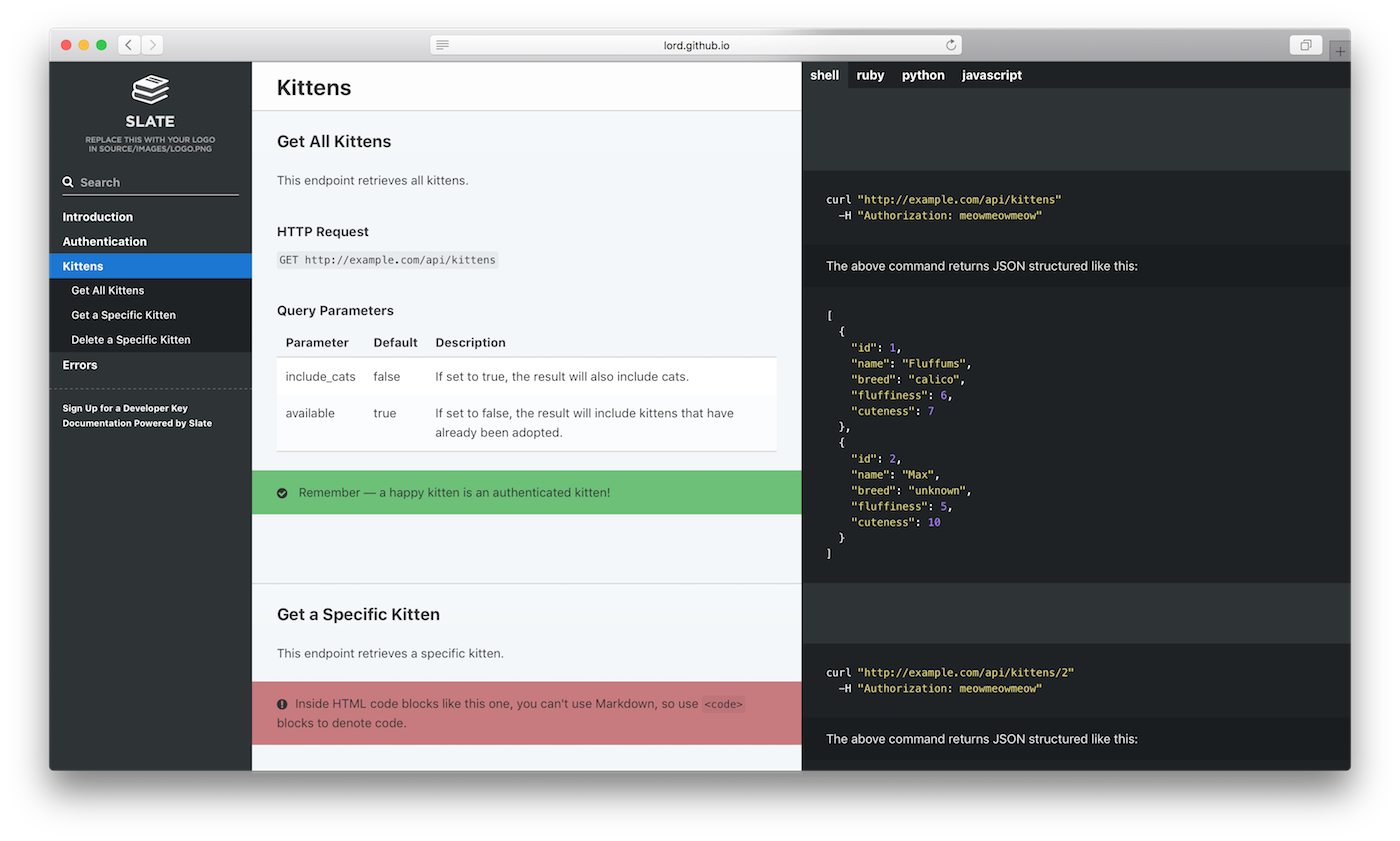
The example above was created with Slate. Check it out at lord.github.io/slate.
-
Clean, intuitive design — With Slate, the description of your API is on the left side of your documentation, and all the code examples are on the right side. Inspired by Stripe's and PayPal's API docs. Slate is responsive, so it looks great on tablets, phones, and even in print.
-
Everything on a single page — Gone are the days when your users had to search through a million pages to find what they wanted. Slate puts the entire documentation on a single page. We haven't sacrificed linkability, though. As you scroll, your browser's hash will update to the nearest header, so linking to a particular point in the documentation is still natural and easy.
-
Slate is just Markdown — When you write docs with Slate, you're just writing Markdown, which makes it simple to edit and understand. Everything is written in Markdown — even the code samples are just Markdown code blocks.
-
Write code samples in multiple languages — If your API has bindings in multiple programming languages, you can easily put in tabs to switch between them. In your document, you'll distinguish different languages by specifying the language name at the top of each code block, just like with GitHub Flavored Markdown.
-
Out-of-the-box syntax highlighting for over 100 languages, no configuration required.
-
Automatic, smoothly scrolling table of contents on the far left of the page. As you scroll, it displays your current position in the document. It's fast, too. We're using Slate at TripIt to build documentation for our new API, where our table of contents has over 180 entries. We've made sure that the performance remains excellent, even for larger documents.
-
Let your users update your documentation for you — By default, your Slate-generated documentation is hosted in a public GitHub repository. Not only does this mean you get free hosting for your docs with GitHub Pages, but it also makes it simple for other developers to make pull requests to your docs if they find typos or other problems. Of course, if you don't want to use GitHub, you're also welcome to host your docs elsewhere.
-
RTL Support Full right-to-left layout for RTL languages such as Arabic, Persian (Farsi), Hebrew etc.
Getting started with Slate is super easy! Simply fork this repository and follow the instructions below. Or, if you'd like to check out what Slate is capable of, take a look at the sample docs.
You're going to need:
- Linux or OS X — Windows may work, but is unsupported.
- Ruby, version 2.3.1 or newer
- Bundler — If Ruby is already installed, but the
bundlecommand doesn't work, just rungem install bundlerin a terminal.
- Fork this repository on GitHub.
- Clone your forked repository (not our original one) to your hard drive with
git clone https://github.com/YOURUSERNAME/slate.git cd slate- Initialize and start Slate. You can either do this locally, or with Vagrant:
# either run this to run locally
bundle install
bundle exec middleman server

# OR run this to run with vagrant
vagrant up
You can now see the docs at http://localhost:4567. Whoa! That was fast!
Now that Slate is all set up on your machine, you'll probably want to learn more about editing Slate markdown, or how to publish your docs.
If you'd prefer to use Docker, instructions are available in the wiki.
For those who don't have JavaScript runtime or are experiencing JavaScript runtime issues with ExecJS, it is recommended to add the rubyracer gem to your gemfile and run bundle again.
- NASA
- IBM
- Sony
- Best Buy
- Travis-CI
- Greenhouse
- Woocommerce
- Appium
- Dwolla
- Clearbit
- Coinbase
- Parrot Drones
- Fidor Bank
- Scale
You can view more in the list on the wiki.
If you've got questions about setup, deploying, special feature implementation in your fork, or just want to chat with the developer, please feel free to start a thread in our Spectrum community!
Found a bug with upstream Slate? Go ahead and submit an issue. And, of course, feel free to submit pull requests with bug fixes or changes to the dev branch.
Slate was built by Robert Lord while interning at TripIt.
Thanks to the following people who have submitted major pull requests:
Also, thanks to Sauce Labs for sponsoring the development of the responsive styles.