
A local-first supply-chain risk scanner that grades every dependency A→F — no API keys, no cloud, no signup.



Your package.json / Cargo.toml is a pile of promises made by strangers on the internet. Some of
those strangers wandered off years ago. Some quietly handed their keys to someone new. Some shipped a
vulnerability you've never heard of. That slow decay is dependency rot, and deprot is the smoke
detector.
Point it at a project and it hands back a report card: a 0–100 score, a letter grade, and an
OK / CAUTION / RISKY verdict for every dependency — and, crucially, the reasons why.
$ deprot

+------------+---------+-------+-------+---------+------------------------------------+
| PACKAGE    | VERSION | SCORE | GRADE | VERDICT | TOP REASON                         |
+=====================================================================================+
| request    | 2.88.2  |  24   | F     | RISKY   | package is deprecated              |
| left-pad   | 1.3.0   |  27   | F     | RISKY   | package is deprecated              |
| chalk      | 6.0.0   |  79   | B     | CAUTION | 1 release in the last 12 months    |
| lodash     | 4.18.1  |  89   | B     | OK      | healthy                            |
| express    | 5.2.1   |  96   | A     | OK      | healthy                            |
| typescript | 7.0.2   |  96   | A     | OK      | healthy                            |
+------------+---------+-------+-------+---------+------------------------------------+

6 dependencies analyzed — 2 risky  1 caution  3 ok
No account. No dashboard. No "connect your repo." Your code never leaves your machine — deprot only
makes read-only calls to free, public data APIs.
cargo install deprotPublished on crates.io. Prefer a binary? Grab one from Releases. Building from source needs Rust 1.90+.
deprot                      # grade the project in the current directory
deprot ./package.json       # or a specific manifest
deprot --recursive          # monorepo? grade every subproject across all 8 ecosystems
deprot --vulns              # vuln-first: every CVE, its severity, and the fix version
deprot --secrets            # scan your own source for leaked API keys / tokens / private keys
deprot --workflows          # audit .github/workflows for CI supply-chain risks
deprot --hygiene            # score the repo's security posture (0–100)
deprot --reach              # which deps are actually imported? (find unused ones)
deprot --malware            # AST-aware scan for dropper / malicious-code signatures
deprot --watch -- npm ci    # run an install/build & flag every outbound connection it makes
deprot --badge > badge.svg  # an embeddable grade badge for your README
deprot --explain lodash     # why did this get that grade? (full breakdown)
deprot --tui                # explore it all in a slick terminal UI
deprot --fail-on risky # exit non-zero for CI — fail the build on RISKYEvery dependency gets a 0–100 score → a letter grade → a verdict:
| Grade | Score | Vibe |
|---|---|---|
| A | 90–100 | fresh, loved, well-run 🌱 |
| B | 75–89 | perfectly fine 👍 |
| C | 60–74 | keep half an eye on it 👀 |
| D | 40–59 | starting to smell 🧀 |
| F | < 40 | actively rotting 🧟 |
Some things are too important to average away — a deprecation, an archived repo, or an
unresolved high/critical CVE slam the verdict straight to RISKY, and --explain tells you
exactly which gremlin did it.
deprot --tui opens a keyboard-driven dashboard: a project-health gauge up top, a navigable list
paired with a grade-distribution chart, and a detail pane with a giant letter grade + animated
signal bars for whatever you've selected. It even greets you with a splash. 😎
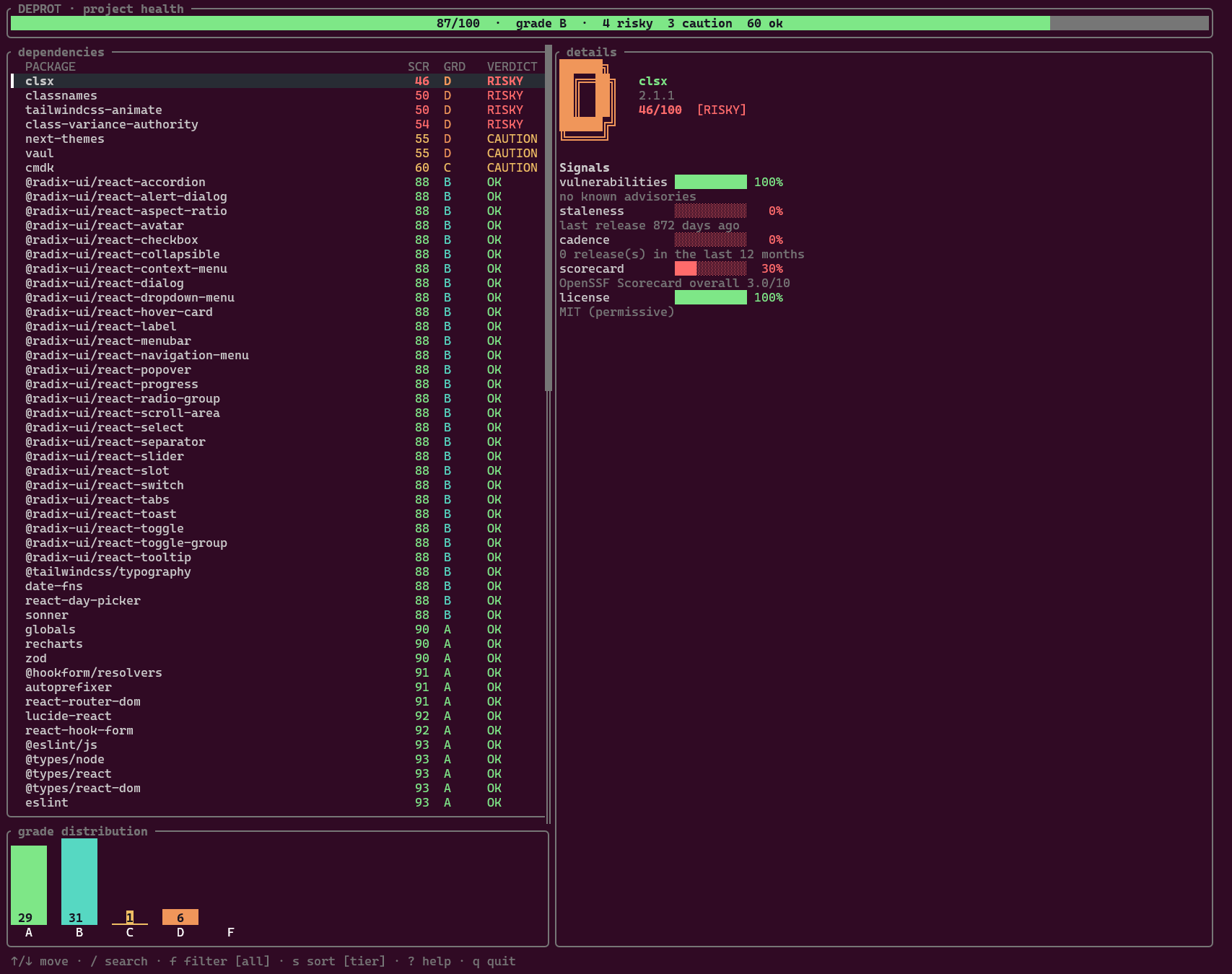
Keys: ↑/↓ move · / search · f filter · s sort · ? help · q quit
The stuff cloud tools don't do locally — all free, all keyless:
- 🌳
--tree— see the whole iceberg. Resolves your entire dependency tree from the lockfile, scores every package at its exact locked version, and shows each one's blast radius (how many of your packages it puts at risk). Then it names the single highest-leverage fix. - ☣️
--malware— catch code that shouldn't be there, with a real parser. For JS/TS/Python it parses the source with tree-sitter and confirms the dropper pattern structurally: aneval/execon a decoded or concatenated payload is flagged even when it's spread across newlines or built by string-concat — and, crucially, it is not flagged when the scary-looking text only appears inside a string or comment (the classic regex false positive). Every finding is taggedAST(parser-confirmed) orregex(heuristic). The regex layer still covers reverse shells (/dev/tcp,nc -e,bash -i),curl | sh, cloud-metadata (IMDS) probes (169.254.169.254), credential-file access (~/.aws/credentials, SSH keys,.npmrc, browser stores), heavy obfuscation, and history tampering.--json/--sarif; fails CI on a high/critical hit. - 📡
--watch— see what an install actually does.deprot --watch -- npm installruns the command and monitors every outbound connection its process tree makes, in real time, from/proc— no root, no packet capture. A compromisedpostinstallthat phones home, an IMDS credential probe (169.254.169.254), or any connection to a public host stands out immediately; loopback/LAN is ignored.--jsonfor CI; exits non-zero on a metadata/external connection. This is a dynamic check most dependency tooling doesn't do locally — and one nobody expects from a "rot" tool. (Linux.) - 🎯
--reach— is the risky dependency even used? Scans your source imports and classifies each dependency as used (with the file it's imported in), unused (a runtime dep never imported — a removal candidate and needless attack surface), or dev. Finer than a runtime-vs-build split, and it cuts alert fatigue: prioritize the risky deps you actually import. npm / Cargo / Go. - 🧰
--hygiene— score your repo's security posture. A keyless, local mini-Scorecard: security policy, a committed lockfile (per ecosystem), a.gitignorethat actually covers secrets, no committed credential files (tracked-only viagit ls-files,.exampletemplates allowed), automated dependency updates, CI, and CODEOWNERS — weighted into a 0–100 grade with per-gap remediation. Fails CI only on a serious gap (e.g. a committed credential), not routine nits. - ⚙️
--workflows— lock down your CI. Audits.github/workflowsfor the current GitHub Actions supply-chain attacks: template injection (untrusted${{ github.event.* }}inrun:), pwn-requests (pull_request_target/workflow_runchecking out untrusted PR code with secrets), unpinned/mutable action refs (not a commit SHA;@mainis worst),write-all/ missing permissions, andcurl | bash.--jsonand--sarif(per-line code-scanning alerts). - 🔑
--secrets— catch leaked credentials before they ship. Scans your own source for hardcoded API keys, tokens, and private keys with high-precision format rules plus entropy analysis, and aggressive false-positive suppression (placeholders,${ENV}refs, doc/example keys,node_modules). Every match is redacted in output; inlinedeprot:allow-secretsuppresses a line.--jsonfor CI,--sariffor per-line GitHub code-scanning alerts. - 🛡️
--vulns— vuln-first CVE audit. Every known advisory across your resolved tree, worst-first: CVE id, CVSS, and the exact version to upgrade to. Vulnerability data is OSV.dev merged with GitHub/deps.dev advisories (a superset of either alone), with CVSS scored from the raw vector.--jsonfor CI,--sariffor per-CVE GitHub code-scanning alerts; exits non-zero if anything's found. - 🗂️
--recursive— monorepo mode. One repo, many subprojects: afrontend/(package.json), abackend/(go.mod),packages/*(Cargo.toml)… deprot discovers every manifest under the directory, grades each in its own section, and fails CI on the worst verdict across all of them. Dependency/build dirs (node_modules,vendor,target, …) are skipped. Point deprot at the repo root and it just works — no more empty-root dead ends. - 📦
--installed— grade what's actually on disk. Scans the real install — yournode_modulesand the active Python environment (importlib.metadata, no lockfile needed) — at the exact versions present, so it catches drift from the lockfile and packages installed by hand. Add--globalto audit machine-wide tooling (npm root -g,pipx). Runs through the same blast-radius /--fix/--fail-onpipeline as--tree. - 🧬
--deep— the xz check. Flags when one maintainer controls a scary share of your supply chain, and which packages run code on install. - 🩹
--tree --fix— a to-do list, not just bad news. Computes the exact upgrades that raise your grades, most impactful first, with the command to run. - 🕵️ typosquat radar. Spots dependencies that are 1–2 keystrokes from a popular package
(
lodahs,expres) — a classic attack, caught offline. - 🔀
--diff base.lock— PR mode. "This change adds 3 deps, 1 RISKY, and moves project health −8." - ⏳
--history express— a time machine. A package's release cadence over the years, its longest quiet spell, and how stale it is now. - 📜 policy-as-code (
.deprot.toml): enforce a team standard with time-boxed waivers. - 🔌
--sarif/--sbom: SARIF for GitHub code scanning, CycloneDX SBOM with risk baked in. ✈️ --offline: fully air-gapped — warm the cache once, then zero network.
Each dependency is reduced to a set of signals, each a 0.0–1.0 subscore with a weight; the final
number is their weighted average (a missing data source lowers confidence, it doesn't nuke the grade).
| Signal | Weight | Measures |
|---|---|---|
deprecation |
4 | Registry-level deprecation |
archived |
3 | Upstream repo is archived (abandoned) |
vulnerabilities |
3 | Known advisories (worst CVSS wins) |
staleness |
2 | Time since the last release |
scorecard |
1.5 | OpenSSF Scorecard (engineering hygiene) |
bus_factor |
1.5 | Contributor concentration |
cadence |
1 | Releases in the last 12 months |
license |
1 | Present & permissive vs. copyleft vs. missing |
| Source | Auth | Gives us |
|---|---|---|
| deps.dev | none | releases, licenses, advisories, linked repo, OpenSSF Scorecard |
| OSV.dev | none | vulnerabilities — CVE aliases, CVSS vectors, fixed versions (merged with deps.dev/GitHub advisories) |
| npm / crates.io / PyPI / Go / RubyGems / Maven / NuGet | none | publish metadata, maintainers/owners, install scripts |
| GitHub API | optional token | deeper repo signals — never required |
Ecosystems (8): npm, crates.io, PyPI, Go, RubyGems, Packagist (PHP), Maven, and NuGet — parsed
from their manifests (package.json, Cargo.toml, go.mod, requirements.txt/pyproject.toml,
Gemfile, composer.json, pom.xml, *.csproj/packages.config) and, where present, their
lockfiles for exact versions. deps.dev doesn't index Packagist, so PHP vulnerabilities come straight
from OSV.
Grading, vulnerabilities, typosquat, tree/blast-radius and SBOM/SARIF span all eight ecosystems.
A few source-analysis features depend on a per-ecosystem scanner that isn't wired everywhere yet —
deprot tells you honestly rather than pretending (e.g. --reach reports unscanned where it has no
importer). Current coverage:
| Ecosystem | Grade & vulns | Lockfile tree | --reach |
--deep maintainers |
|---|---|---|---|---|
| npm | ✓ | ✓ | ✓ | ✓ |
| crates.io | ✓ | ✓ | ✓ | ✓ |
| Go | ✓ | — | ✓ | — |
| PyPI | ✓ | via --installed |
— | — |
| RubyGems | ✓ | ✓ | — | — |
| Packagist | ✓ (OSV) | ✓ | — | — |
| Maven | ✓ | — | — | — |
| NuGet | ✓ | — | — | — |
Results are cached on disk (24h TTL) so re-runs are instant and polite to the APIs.
Drop a .deprot.toml in your repo and deprot becomes an enforceable standard that fails CI:
# .deprot.toml
min_score = 60
max_age_days = 730
required_scorecard = 4.0

[licenses]
deny = ["GPL-3.0", "AGPL-3.0"]

[packages]
deny = ["request", "left-pad"]

[[waivers]]
package = "lodash"
reason  = "risk accepted for Q1; migration tracked in JIRA-123"
until = "2026-06-01" # expires — no permanent rug-sweeping# .github/workflows/deps.yml
name: dependency check
on: [pull_request]
jobs:
deprot:
runs-on: ubuntu-latest
steps:
- uses: actions/checkout@v4
- uses: LouayeG/deprot@main
with:
fail-on: riskyA small Cargo workspace with a strict "pure core, I/O at the edges" split — so the whole scoring engine is deterministic and testable with zero network:
deprot-manifest   parse manifests + lockfiles  ->  Dependency / DepGraph
deprot-collect    fetch public data            ->  Facts      (the only crate that hits the network)
deprot-core       Facts                         ->  Score      (pure, zero-I/O, fully deterministic)
deprot-report     Score                         ->  table / JSON / SARIF / SBOM / --tree
deprot-policy     Facts + Score                 ->  policy violations (.deprot.toml)
deprot-tui        Score                         ->  interactive ratatui browser (--tui)
deprot-cli        wires it all together + owns the CLI
git clone https://github.com/LouayeG/deprot && cd deprot
cargo build --release      # → target/release/deprot
cargo test --workspace # the whole suite runs offlineDeep tarball capability scanning · bundled offline OSV mirror · SBOM ingest · a grade badge you can
embed in your own README · maintainer/typosquat data for the newer ecosystems · --watch on macOS.
PRs welcome — new ecosystems are the easiest place to start.
Dual-licensed under MIT or Apache-2.0, your choice.