
[User's manual] (https://docs.google.com/document/d/11FkfCGAwbjfrn9U07EkIZRNuXmvY6PJt67DFNQU_mW8/pub) online (most up-to-date version) or [PDF] (https://drive.google.com/file/d/0B13IeWPRjYq8WFFTUk1FemRSdzA/view?usp=sharing).
[QDYN software and examples] (https://drive.google.com/folderview?id=0B13IeWPRjYq8c2h5SGFsWDVyZ1k&usp=sharing).
August 2016: In the following paper we used QDYN to simulate earthquake cycles and obtained events spanning a broad range of magnitudes to study earthquake scaling relations:
Y. Luo, J. P. Ampuero and K. Irikura
Free surface effects on earthquake moment-area scaling relations
Submitted to PAGEOPH, Topical Volume on "Best Practices in Physics-based Fault Rupture Models for Seismic Hazard Assessment of Nuclear Installations"
QDYN was previously hosted on [GoogleCode] (https://code.google.com/p/qdyn/) and is now on [Github] (http://ydluo.github.io/qdyn). Both [SVN] (https://subversion.apache.org) and [GIT] (https://git-scm.com) version control systems are supported.
A QDYN tutorial session was offered at the [School on "Earthquakes: nucleation, triggering and relationship with aseismic processes"] (http://earthquakes.sciencesconf.org/) at Cargese, Corsica, 3 - 10 November 2014
QDYN is a boundary element software package to simulate earthquake cycles (tectonic fault slip) under the quasi-dynamic approximation (quasi-static elasticity with radiation damping).
The code implements adaptive time stepping and shared-memory parallelization to simulate earthquake cycles including seismic and aseismic slip. QDYN includes various forms of rate-and-state friction and state evolution laws. It handles non-planar fault geometries in 3D and 2D elastic media, as well as spring-block simulations. It has a user-friendly matlab interface and graphical output.
- rate-and-state friction, with velocity cut-offs, aging and slip laws
- heterogeneous frictional properties
- slow and fast, aseismic and seismic slip transients
- non-planar faults (currently limited to variable dip, rectangular elements)
- 3D, 2D and 1D (spring-block)
- tectonic and transient loads
- matlab wrapper and graphic output display utilities
- parallelized for shared memory systems (OpenMP)
- normal stress coupling
- fully coupled with SPECFEM3D via QSB (QDYN-SPECFEM Bridge)
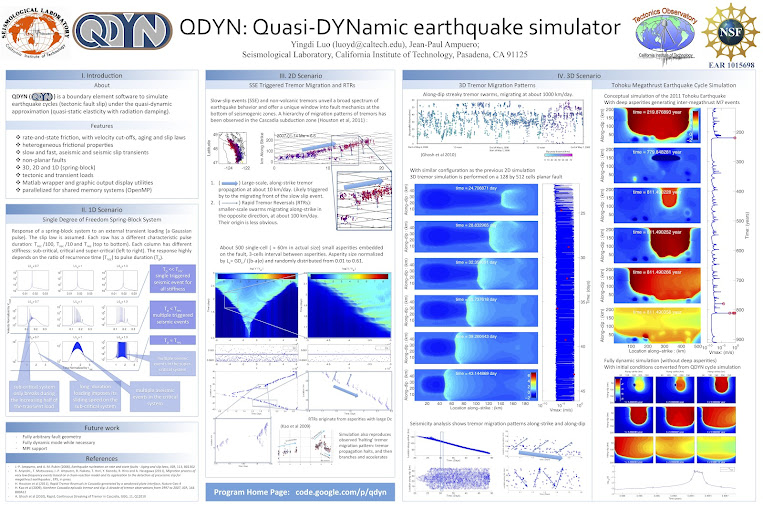
[Download Poster] (http://code.google.com/p/qdyn/downloads/detail?name=Poster_QDYN.pdf)


QuakeID Group, Caltech Seismo Lab:
[Yingdi Luo] (http://www.seismolab.caltech.edu/luo_y.html)
[Jean-Paul Ampuero] (http://www.seismolab.caltech.edu/ampuero_jp.html)
[Bryan Riel] (http://www.seismolab.caltech.edu/riel_b.html)
Percy Galvez (AECOM, Switzerland)
For questions, feedback or suggestions, please contact the developers via the [issue tracking system] (https://github.com/ydluo/qdyn/issues).
Y. Luo, J. P. Ampuero (2011), Numerical Simulation of Tremor Migration Triggered by Slow Slip and Rapid Tremor Reversals, AGU Fall Meeting 2011 Abstract S33C-02
Y. Luo, J. P. Ampuero (2012), Simulation of Complex Tremor Migration Patterns, AGU Fall Meeting 2012 Abstract S44B-02